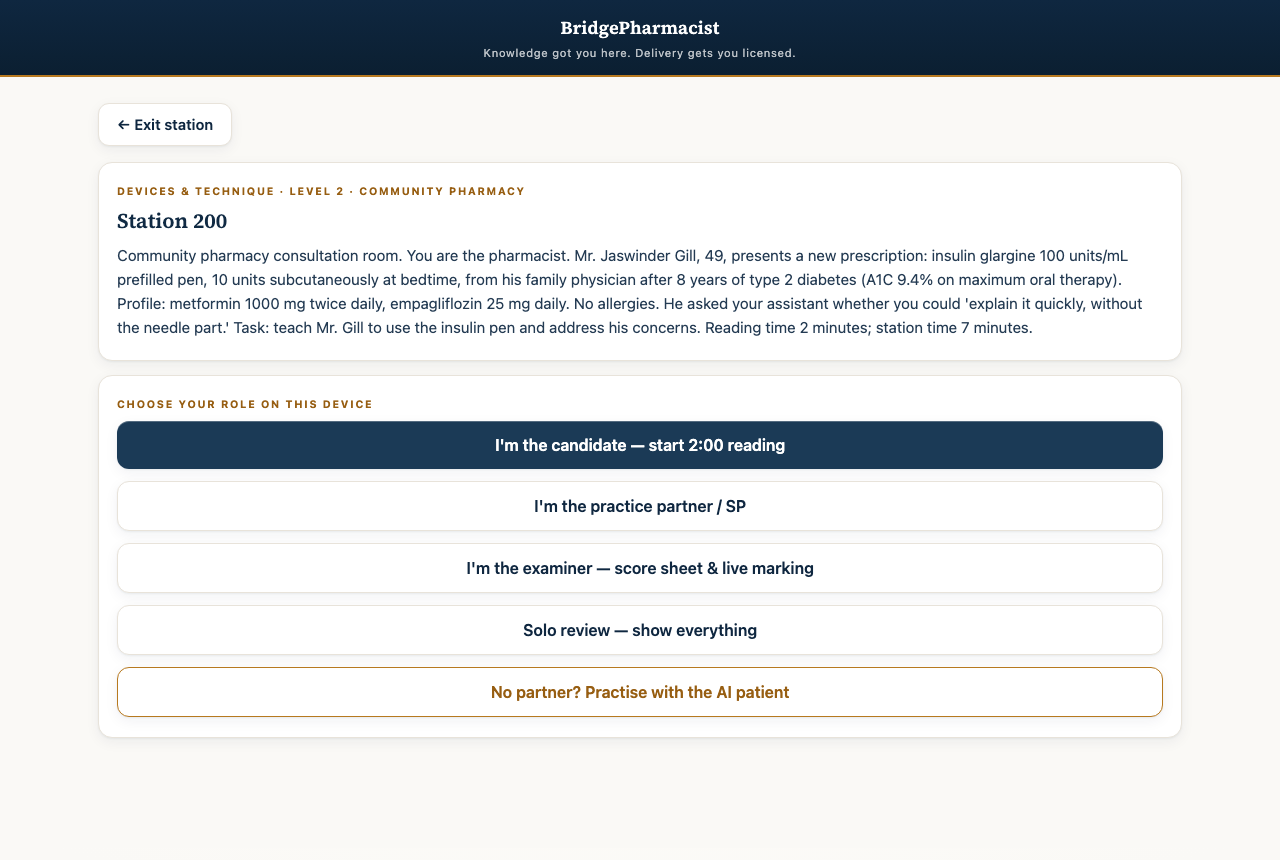
Sample station · Station 200 · Devices & technique · Level 2
First insulin pen with a needle phobia
The door note — all you get before the 2:00 reading timer starts
Community pharmacy consultation room. You are the pharmacist. Mr. Jaswinder Gill, 49, presents a new prescription: insulin glargine 100 units/mL prefilled pen, 10 units subcutaneously at bedtime, from his family physician after 8 years of type 2 diabetes (A1C 9.4% on maximum oral therapy). Profile: metformin 1000 mg twice daily, empagliflozin 25 mg daily. No allergies. He asked your assistant whether you could 'explain it quickly, without the needle part.' Task: teach Mr. Gill to use the insulin pen and address his concerns. Reading time 2 minutes; station time 7 minutes.
The simulated patient's script — what your practice partner (or our AI patient) plays
Opening line: "So — funny story — I fainted once giving blood. Just tell me the gist and I'll figure the rest out at home, yeah?"
Affect: jovial deflection over visible tension; jokes constantly, angles his chair away when the pen comes out.
Stated concern: wants the teaching to skip or minimize the injection itself.
Hidden concern (revealed only if you ask what insulin means to him): he believes starting insulin means his diabetes is "end-stage" and that he failed — his uncle started insulin and died within two years, and he privately connects the two.
Pushback: if shown the needle abruptly or told "it's nothing, don't be a baby" — he goes quiet, then "You know what, I'll come back another day" and moves to leave.
Acceptance: after the fear is named and the actual 4 mm needle is shown next to a coin for scale, he handles the pen, does a practice air-shot, and agrees to a plan — even a supervised first injection instead of solo tonight.
Examiner checklist — excerpt
Asks what he already knows and what starting insulin means to him before demonstrating
Reframes insulin as a normal treatment step, not a failure or terminal marker
Shows the 4 mm pen needle for scale; demonstrates prime, dial, 90° insertion, the device's specified hold time, sharps disposal
Adapts "bedtime" dosing to his rotating night-shift schedule
CRITICAL FAIL — administers or compels an injection without his valid consent
This is an excerpt — the full station has 15 checklist items across all three scoring dimensions (technique, storage, hypoglycemia teaching, shift-work timing, sick-day guidance and follow-up), plus a debrief keyed to the BRIDGE phases. Every interactive station is built this way; the collection also includes written, checking and calculation drills.
Notice what this station is testing. Not insulin facts alone — you know those. It tests whether you find the hidden belief, name the fear, and still land the teaching inside seven minutes. That gap between knowing and delivering is the whole product.